
The New Aadhaar App Design
Reimagining the Sarkari experience

Overview
To change Aadhaar from a document that people carry into a digital identity that people can manage, the Aadhaar App was conceptualized.
Timeline
Timeline
8 Months
My Role
My Role
UX Designer
Real Impact
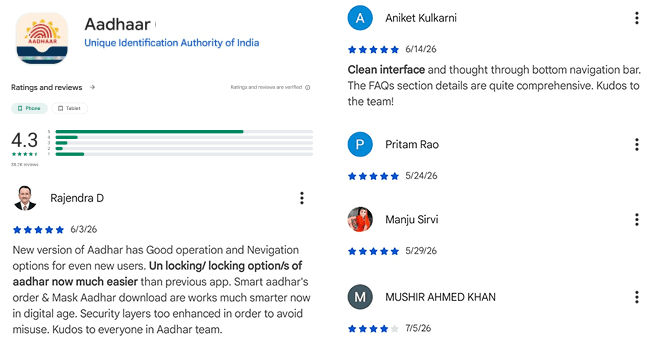
5.5 Crore +
App Downloads
in 6 months
107 Lakhs +
Aadhaar Updates
via App
2.75 Crore +
Biometrics Locked/
Unlocked
83.8%
Task Completion Rate in Services
23.8% ↑
Onboarding Success Rate
Design Process
Designing at High Stakes
At UIDAI, every product/ feature operates within an existing national-scale technical infrastructure and a framework of laws, rules, regulations, and amendments. Changes therefore require careful evaluation, not just from a UX perspective, but across technical feasibility, legal compliance, security, and multiple internal teams.
The result is a design process that looks less like a straight line and more like this:

Problem
Problem Statement
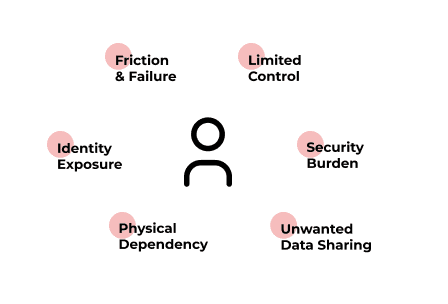
The Aadhaar experience was largely centred around presenting a physical document, revealing personal information, and trusting the verifier with it. Managing the identity itself has not always been a seamless self-service experience.
There has always been a gap between having a secure identity and having the agency to manage, protect, share, and understand it on your own terms.

Solution
Identity Management via Mobile Application
Privacy by Default
Inspired by a real-world, the Aadhaar App keeps your Card inside the sleeve securely masked by default until user reveals it
Share Only What's Needed
Selective Sharing reveals only the information
required for a transaction, nothing more.
Manage Identity with Ease
Keep Aadhaar details updated and multiple profiles can be managed from a single, secure app.

Track Identity
Authentication History keeps every verification transparent, always know where and when
user’s identity was used.
Verify Anywhere
Secure QR-based verification works even without connectivity, reducing reliance on physical documents.
Secure in One Tap
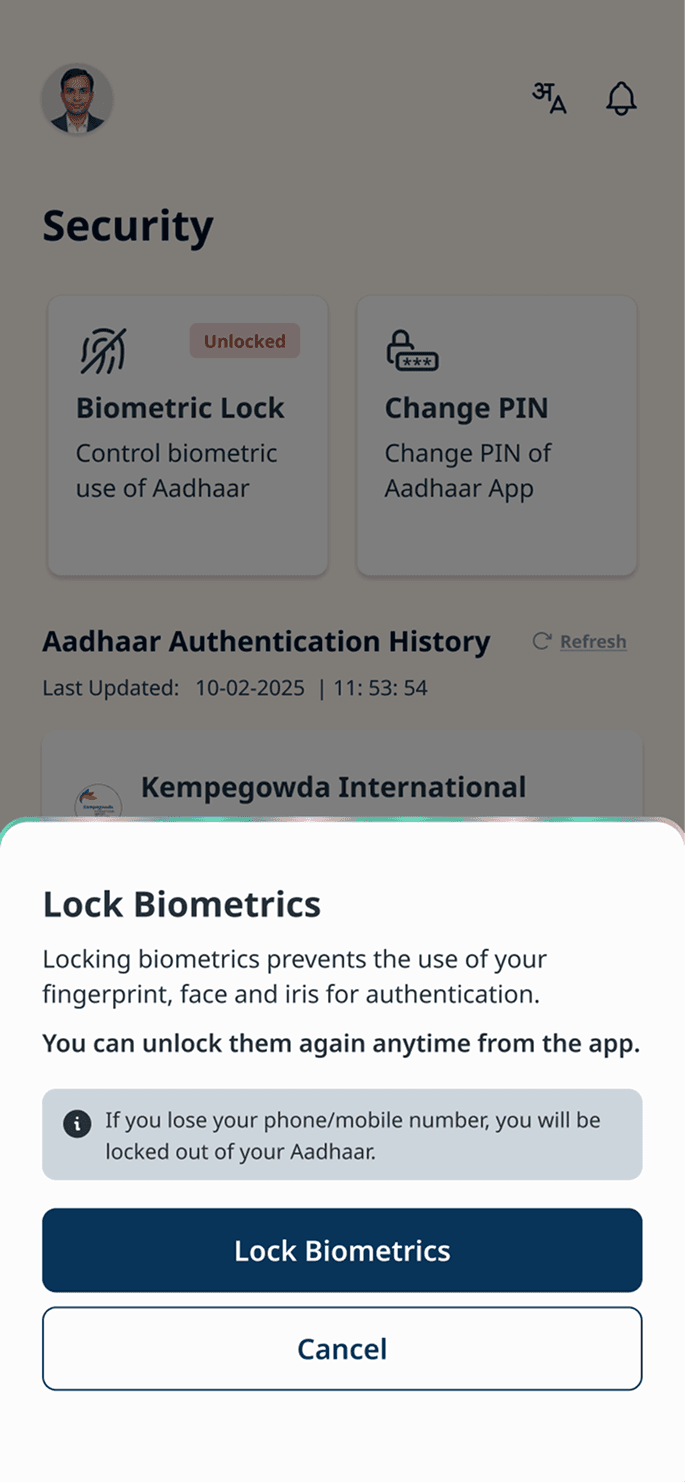
Users can instantly lock or unlock Biometrics,
keeping control in their own hands.
Research
Structuring the Experience
At Aadhaar’s scale, no small set of participants can represent the whole. Research was not a linear phase, but a continuous practice, moving between understanding the ecosystem and its users, structuring information and experiences, research through design, and validating decisions.
Understanding the Ecosystem
Secondary research ·
Policy & regulation · Backend & infrastructure · Service-centre exploration · Benchmarking
Secondary research · Policy & regulation · Backend & infrastructure · Service-centre exploration · Benchmarking
Understanding Users
Field visits ·
Interviews · Surveys ·
User scenarios ·
Role-play ·
Contextual research
Field visits · Interviews · Surveys · User scenarios · Role-play · Contextual research
Structuring the Experience
Card sorting ·
Information architecture · Content grouping ·
Mental models ·
Journey mapping
Card sorting · Information architecture · Content grouping · Mental models · Journey mapping
Research Through Design
Rapid prototyping ·
Design probes ·
Exploring concepts · Testing assumptions
Rapid prototyping · Design probes · Exploring concepts · Testing assumptions
Validating & Iterating
Usability testing ·
Prototype testing · Feedback loops ·
Iterative refinement
Usability testing · Prototype testing · Feedback loops · Iterative refinement

Scale of Diversity
140+ crore
Population of India
22
Official Languages
66+ crore
Smartphone Users, as of 2024
80+ crore
Internet Users, as of 2025

Findings
Across these methods, a few recurring patterns shaped the design direction.
1
Uncertainty
“I don’t know where to go.”
Multiple offices, multiple
processes, unclear ownership.
2
Dependence
“I need someone else to help.”
Agents, operators, third parties often become part of the journey.
3
Friction
“Updates are time-consuming.”
Queues, waiting, repeat verification, and multiple steps add effort.
4
Exposure
“I share all of my Aadhaar.”
Photocopies, screenshots, downloaded documents increase exposure.

Design
Information Architecture
Implementing the mental models and user behaviour we uncovered, we restructured the Information Architecture.

Design
Design Principles
01 . Comprehension
02 . Familiarity & Learnability
03 . Transparency & Control
04 . Forgiving & Recoverable
01 . Comprehension
Make the experience Easy to Understand
Instructional design
Jargons simplified & explained
Visual aids to support understanding


02 . Familiarity & Learnability
Make the experience Predictable
Progressive disclosure
Meaningful navigation
Consistent UI & interaction patterns


03 . Transparency & Control
Keep users Informed and in Control
Feedback after actions
Meaningful confirmations
Status and progress visibility

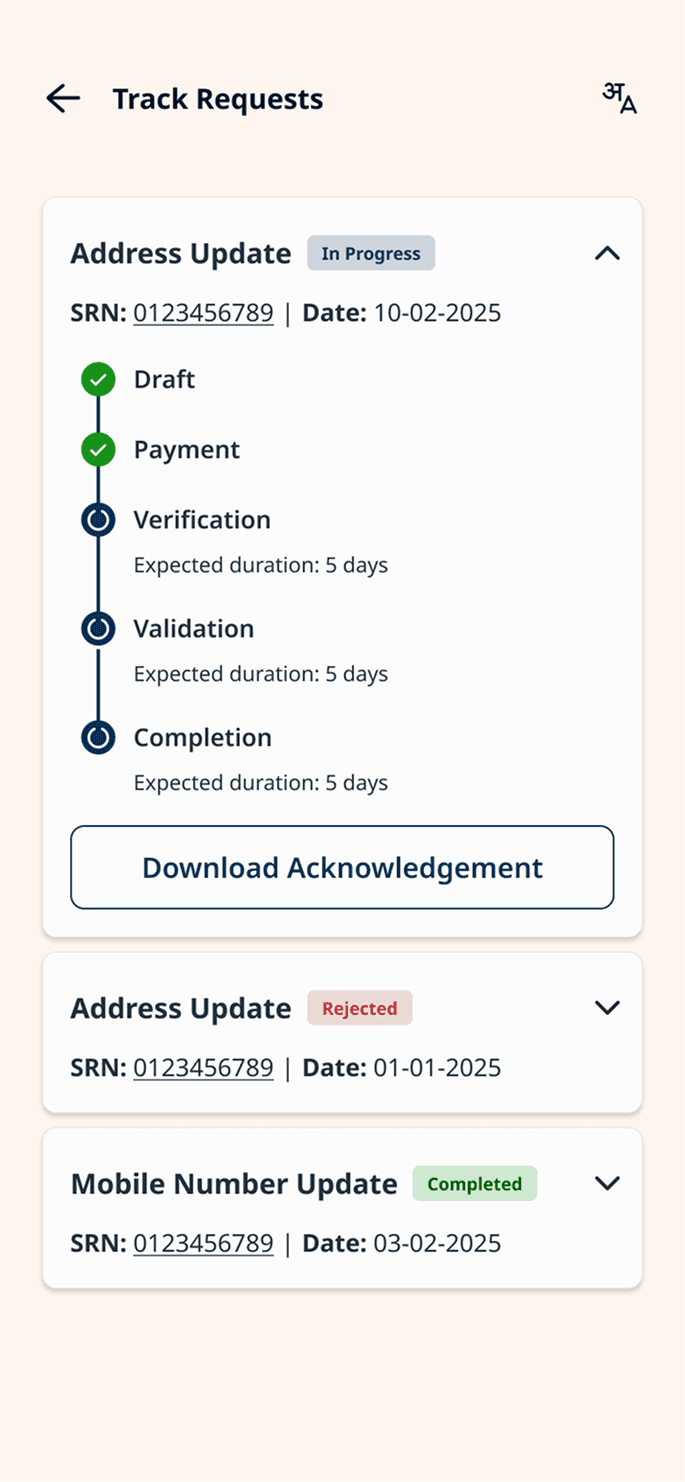
04 . Forgiving & Recoverable
Keep users Informed and in Control
Affordance and anticipation for human error
Undo, re-routing, and correction where appropriate

The Change
From Dependance to Independence
Before App


Physical centres could be crowded, inaccessible due to infrastructure, far away from home. While online services were often complex enough to require intermediaries.
User Flow & Prototype
With Aadhaar App
Update your Aadhaar address independently, in your own comfort.

1,07,50,000 +
People Choose to Update their Aadhaar from the comfort of their home so far

Milestone & Learnings
My Learnings
This project taught me to let data guide design decisions, especially when designing at a scale of millions, while balancing user needs with technical constraints and feasibility. It reinforced the importance of a comprehensive design process over a predetermined direction, and taught me to navigate competing priorities, compromises, timelines, and teams without losing sight of the user experience.

Big & Small Milestones

Yayyyyyyyyy you made it! Thank you all for reading through this case study!

